

A speedometer tells you how fast you’re going. The trip meter tells you how far you’ve travelled.
kW and kWh have the same relationship: kW is the pace; kWh is the amount that adds up over time.
That one distinction helps you read an electricity bill, compare batteries and understand why switching everything on together can matter.
Think of a road trip
Driving at a steady 60 km/h for half an hour takes you 30 kilometres. Running equipment at a steady 2 kW for half an hour uses 1 kWh.
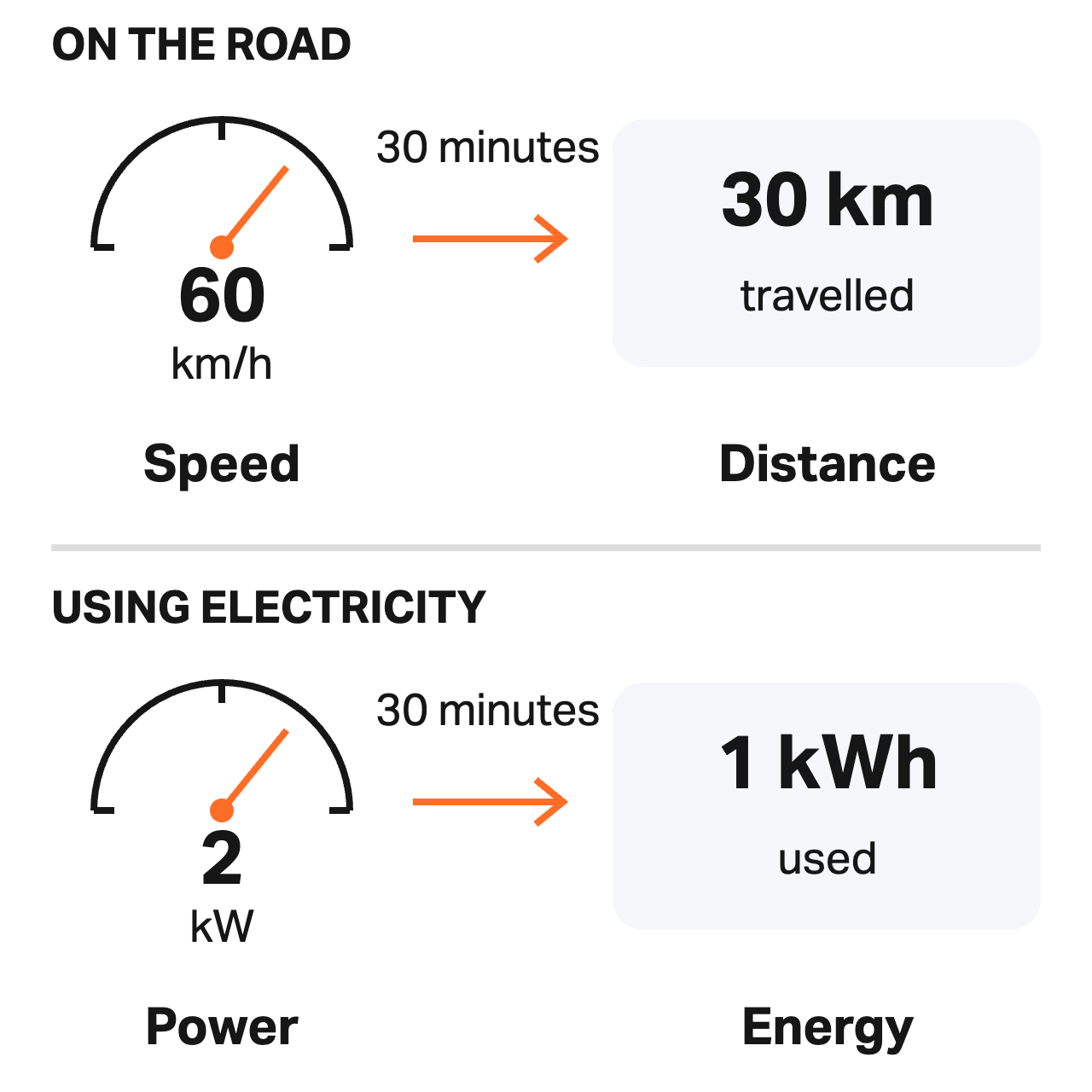
You wouldn’t answer “How far did you drive?” with “60 kilometres per hour.” Likewise, “How much electricity did we use?” needs an answer in kWh, not kW.
- kW — kilowatts — measures power: how quickly electricity is being used, generated or supplied.
- kWh — kilowatt-hours — measures energy: how much electricity is used, generated or stored.
A kilowatt is 1,000 watts. A 2,000 W appliance and a 2 kW appliance have the same power rating.
The “hour” doesn’t mean you must wait an hour
A kilowatt-hour is an amount of energy. You can use it quickly or slowly.
Imagine a heater drawing a steady 2 kW:
| Time running | Energy used |
|---|---|
| 15 minutes | 0.5 kWh |
| 30 minutes | 1 kWh |
| 1 hour | 2 kWh |
| 2 hours | 4 kWh |
The calculation is power × time = energy. Use hours for the time: 30 minutes is half an hour, so 2 kW × 0.5 hours = 1 kWh.
These are made-up examples with constant power. Real equipment may cycle on and off or change its draw. A label saying “2 kW” doesn’t mean it uses 2 kWh every hour it’s plugged in.
Two heaters walk into a chilly shop
Each heater draws 2 kW. Each runs for one hour. You have two ways to use them:
Together: both run during the first hour, then both switch off. They draw 4 kW while running.
One after the other: one runs in the first hour, the other in the second. They draw 2 kW throughout.
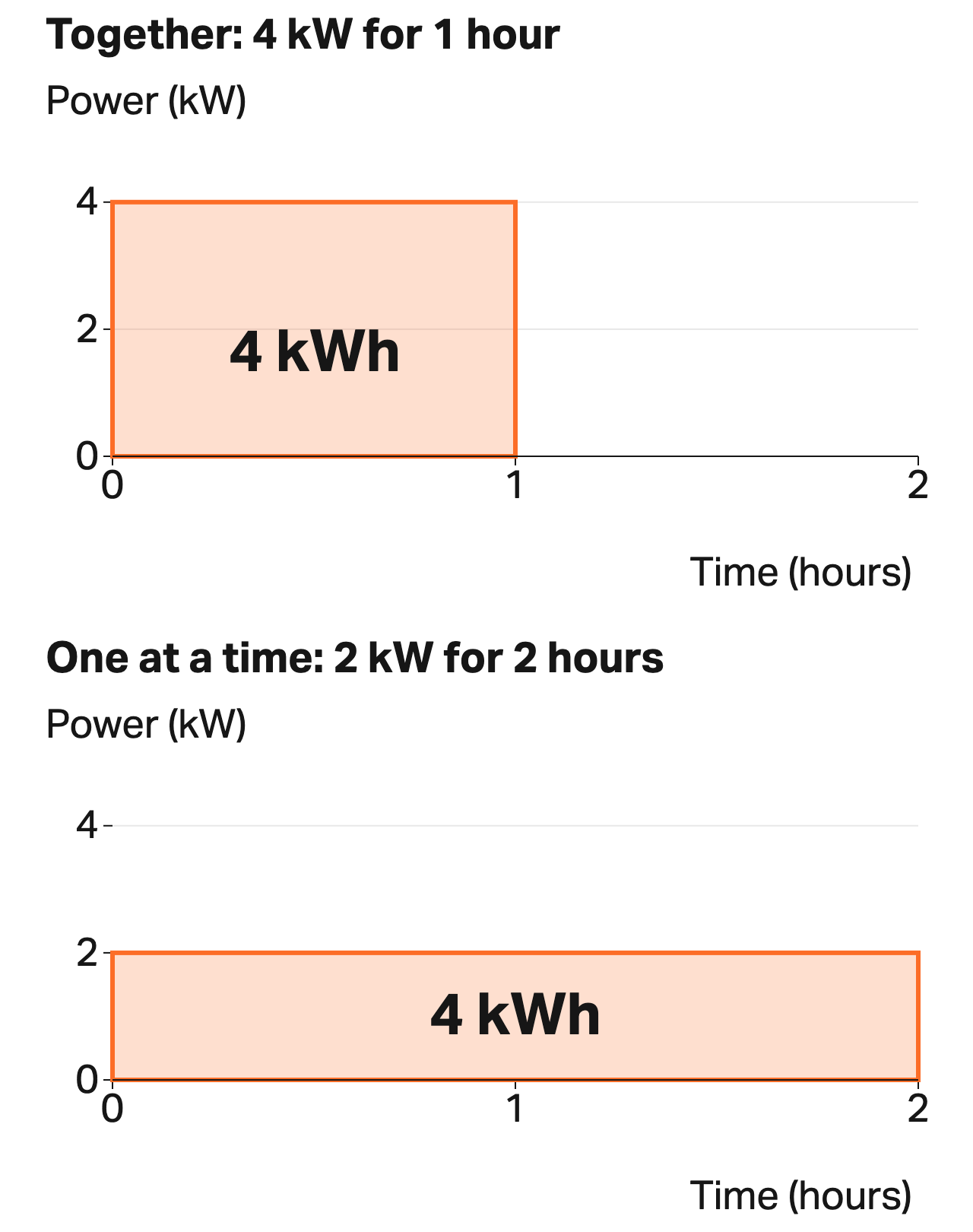
Same energy. Different rush.
The taller shape needs more power at once. The wider shape spreads the same energy over more time.
It also explains why a battery’s kW rating matters, and why some electricity bills include a demand charge.
A battery needs two numbers
A battery’s capacity in kWh tells you how much energy it can store. Its power output in kW tells you how much equipment it can run at once.
Imagine a battery with 10 kWh available to supply equipment, after allowing for losses and any energy kept in reserve. Assume it can deliver at least 5 kW continuously.
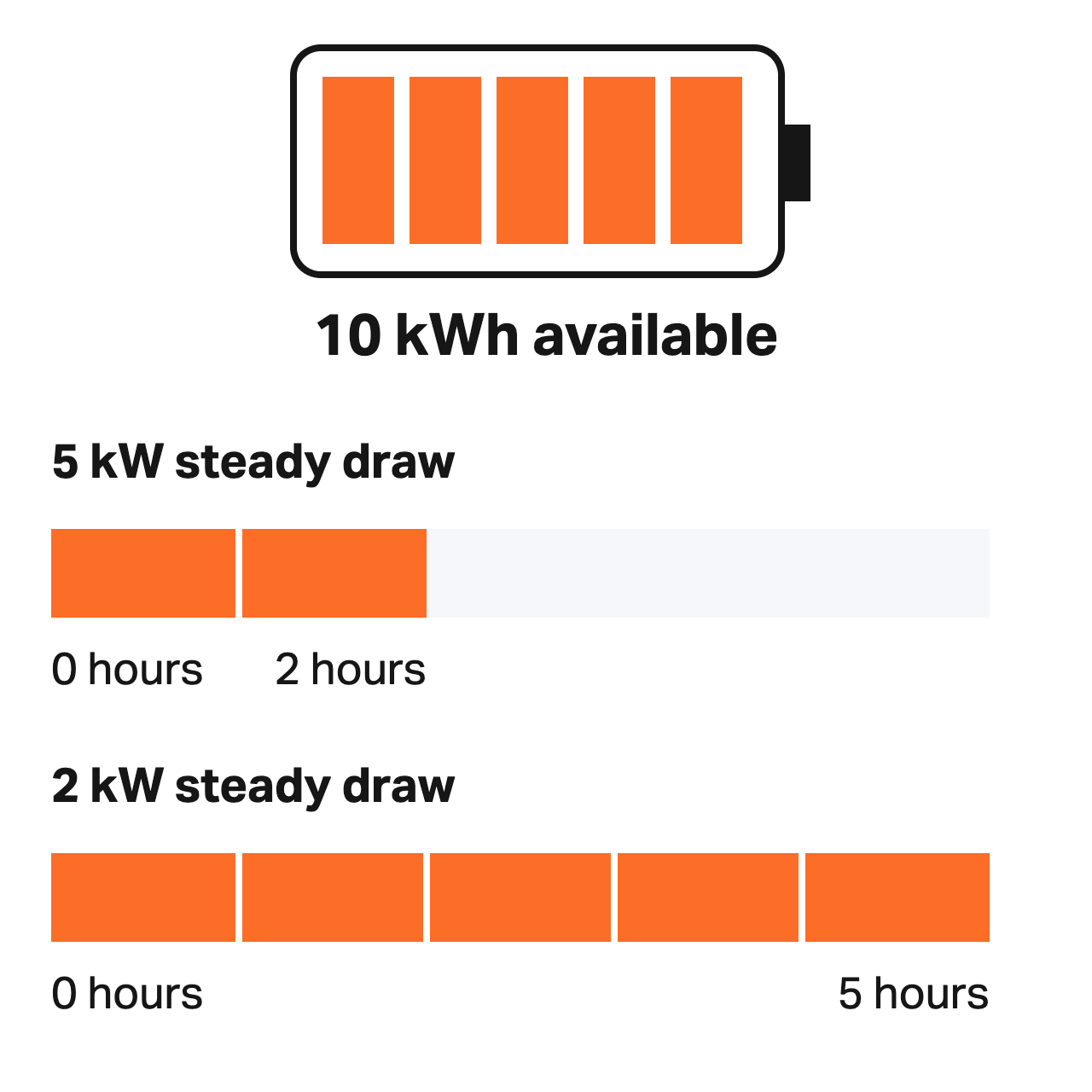
At 5 kW, that energy lasts two hours. At 2 kW, it lasts five.
But a battery limited to 5 kW cannot supply an 8 kW draw on its own, even when full. Enough energy to last and enough power at once are different checks. Outage backup also depends on how the system is configured.
Where you’ll see each unit
| What you’re looking at | What the number tells you |
|---|---|
| Electricity usage: kWh | How much energy was recorded over the billing period. |
| Demand: often kW | The power level used in a demand-charge calculation. Measurement and pricing rules depend on the tariff. |
| Solar system rating: kW | Rated power. Daily energy production in kWh depends on conditions and hours of generation. |
| Battery capacity: kWh | Stored energy. Check whether the figure is total or usable capacity. |
| Battery output: kW | How much power it can supply at once. Check continuous output, not only a short peak rating. |
Try it without a calculator
Which uses more energy: 1 kW for two hours, or 2 kW for one hour?
Both use 2 kWh. The second draws twice the power for half the time.
And does “kWh” mean “kilowatts per hour”? No. It means kilowatts multiplied by hours. To turn kW into kWh, you need to know how long that power is used.
To put these units in context, read Understanding your business electricity bill in NSW.
Sources
- Australian Government — batteries: capacity, output and backup configuration.
- Energy Made Easy — electricity tariffs: usage and demand charges.
All numerical examples and diagrams in this guide are illustrative.