

The ovens are on, the dishwasher starts and the air conditioning is working hard. For half an hour, your business needs a lot of power at once.
On some electricity tariffs, a busy period like that can affect more than the electricity you use that afternoon. It can help set a separate charge on your bill: a demand charge.
What is a demand charge?
A usage charge is based on how much electricity you use. A demand charge is based on a measure of how much power you draw from the grid at once.
The network has to be able to deliver electricity during busy periods. Demand pricing is one way it charges for that capacity. Your retailer decides how those costs appear in your electricity offer.
Not every offer has a separate demand charge.
kW and kWh, in two lines
kWh is the amount of electricity used, like the distance travelled on a road trip.
kW is how quickly it’s being used, like your speed. Demand calculations often use an average over a set period, rather than a momentary spike.
For the pictures and examples, see kW vs kWh: a visual guide to power and energy.
How a busy half-hour becomes a bill charge
One common approach uses the highest average demand recorded during specified times in the month.
Here’s an illustrative version: the meter records half-hour averages, only the tariff’s specified times count, and the highest eligible reading is 20 kW.
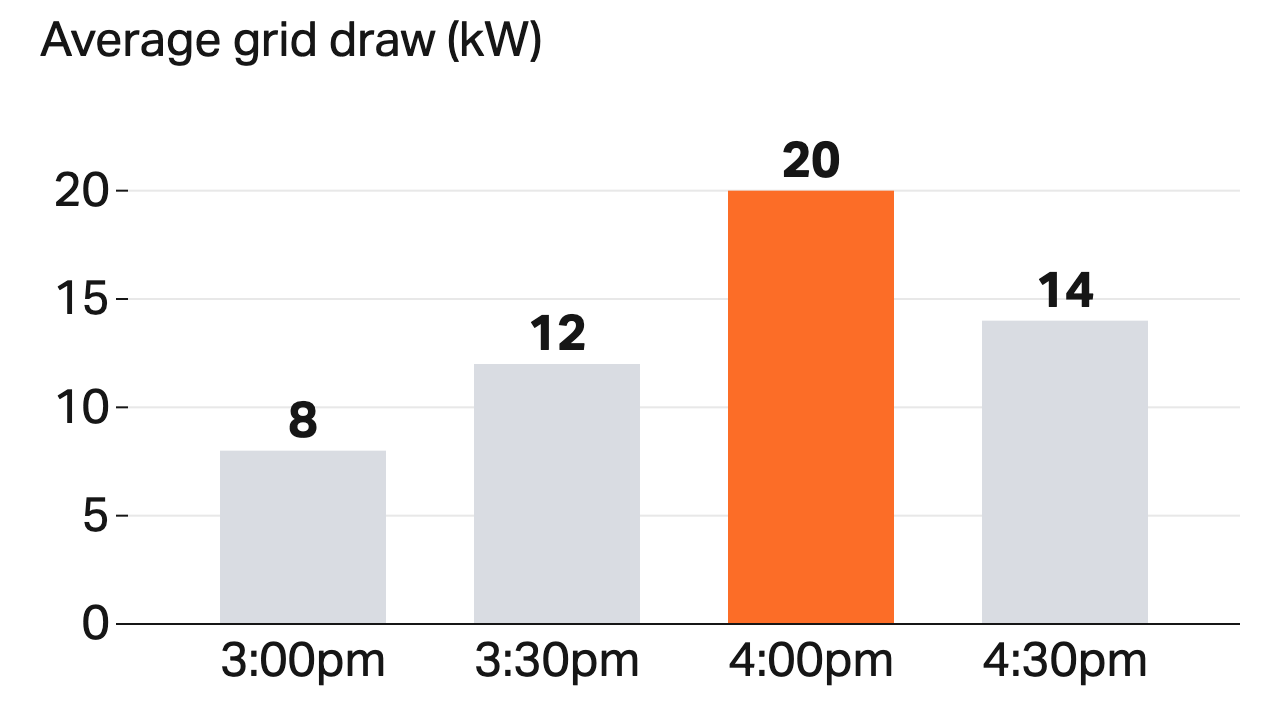
The demand line uses 20 kW × the daily demand rate × the number of days charged.
Electricity actually used during the month is billed separately in kWh. The demand charge pays for the selected power level.
That’s why reducing total electricity use may not reduce this charge: the busy period that sets it could stay the same.
Check your tariff’s rules: the measurement period, which readings count and the unit used can differ. Some tariffs measure demand in kVA.
What to ask your retailer
Ask them to show you the calculation behind the demand line:
- Which times count? Some tariffs count only certain hours, days or seasons.
- Which reading set this bill? Ask for its date, time and how long the measurement covers.
- How did that reading become this dollar amount? Ask which rate, number of days and any minimum or earlier-period rule they applied.
Once you know what sets the charge, you can judge whether a change would help. Spreading flexible tasks across different times may reduce the peak. A battery can supply some of the power when equipment is busy, reducing what the site draws from the grid.
Check the tariff, battery power, available energy and operating schedule before estimating a saving. Any change to equipment timing also needs to work for your business.
How Cable handles demand charges
Cable doesn’t charge customers demand charges. Cable’s offer has a 3-year term and a refundable deposit, with refund and early-exit conditions set out in the agreement.
The network costs don’t disappear. Where network demand charges apply, Cable still pays them. We don’t pass them through as a separate demand charge on your bill.
We use the Cable battery to bring those costs down: charge it at suitable times, then use stored energy when the site would otherwise draw more from the grid. The battery stays Cable’s asset and we operate it. Its available energy and power limit how much demand it can reduce.
You pay a 24/7 flat rate for electricity used, plus a daily supply charge. More usage still means a higher bill. Annual CPI adjustments and other rate changes permitted by the agreement remain separate.
A missing demand line alone doesn’t prove an offer is cheaper overall. See what Cable would quote for your site and compare the complete cost.
Sources
- Energy Made Easy — electricity tariffs: how usage and demand pricing differ.
- Ausgrid — demand pricing: network capacity, the half-hour example and retailer pricing.
- Australian Government — batteries: battery power, capacity and peak-demand reduction.
- Cable — frequently asked questions: customer charges, the Cable battery and offer conditions.