

A battery can create value by changing when your business buys electricity from the grid or uses its own solar. Whether it is worthwhile depends on your electricity prices, how the battery runs and the complete cost of the arrangement.
Your equipment can keep working when it needs to. The battery stores electricity earlier and supplies some of that power later. The proposal needs to show what this changes on your bill and who is responsible for delivering it.
What changes when a battery runs?
A battery connected on your side of the electricity meter is often called “behind the meter”. It can supply some of the power your equipment needs, reducing what comes from the grid at that moment.
The same equipment can keep doing the same work. Here is an illustrative example with a constant 30 kW equipment load:
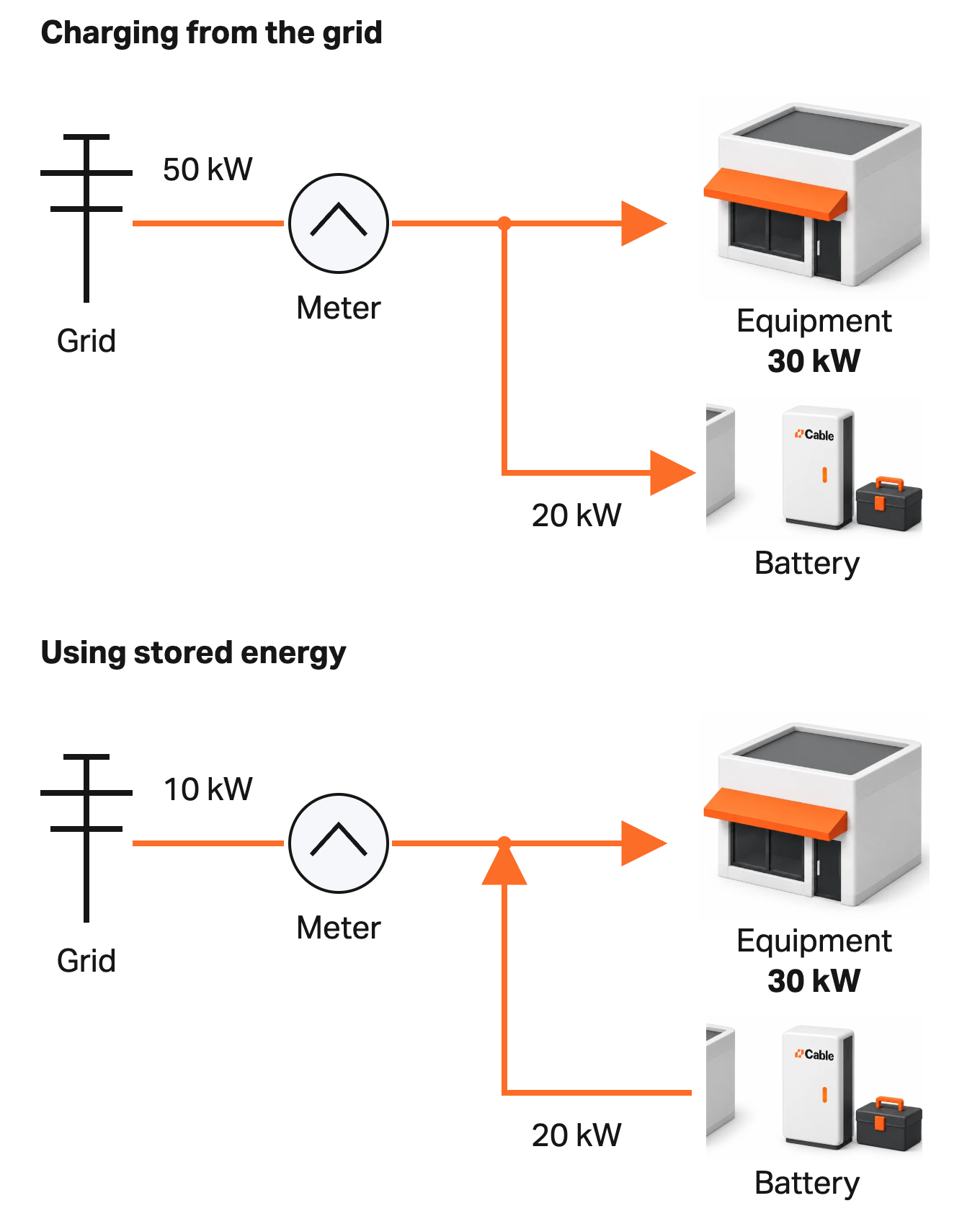
While the battery charges at 20 kW, the grid supplies 50 kW: 30 kW for the equipment and 20 kW into the battery.
While the battery supplies 20 kW, only 10 kW comes from the grid. Together they meet the equipment’s 30 kW requirement.
The business is still using the same equipment power. What changes is when electricity is bought from the grid. Charging and discharging also lose some energy, so a cost estimate must account for that loss.
Solar is not essential to every battery arrangement. A battery can store grid electricity for later use; with a suitable solar installation, it can also store generation from the site.
When electricity is cheaper, and when the battery helps
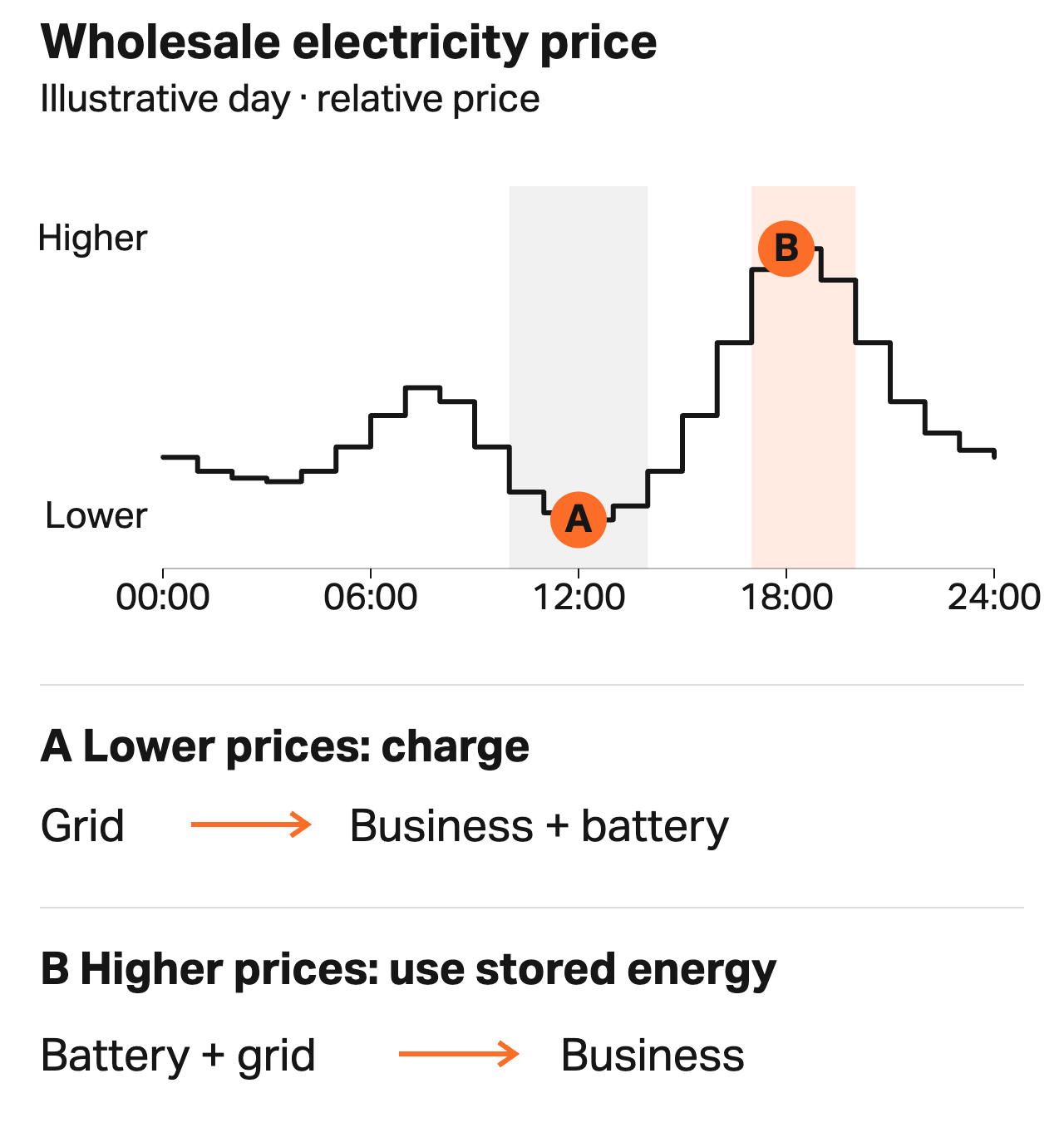
At lower prices, the grid supplies the business and charges the battery; at higher prices, the battery supplies some of the business’s power and the grid supplies the rest.
Actual prices and operation vary by site and day. Cable customers pay their agreed flat rate; losses, capacity and network costs also affect battery operation.
Where does the value come from?
For a business paying different prices at different hours, a battery can shift grid purchases into cheaper periods. The price difference needs to cover the losses and costs involved.
Where demand charges apply, supplying equipment from a battery can reduce the power drawn from the grid during the periods used to calculate the charge.
With solar, storing surplus generation can avoid a later grid purchase. The comparison also needs to account for any export credit you give up by storing that electricity.
Some arrangements involve an operator coordinating batteries across several sites. The customer’s benefit then depends on the electricity price, payments or other terms offered in return.
The proposal should connect the operating strategy to what your business receives. Moving grid purchases between hours does not by itself lower a usage charge that is the same all day.
The model matters as much as the battery
Buying a battery, financing one and taking electricity supplied through a battery arrangement put different costs and responsibilities on the business.
For any proposal, get the responsibilities in writing:
| Question | Get a clear answer on |
|---|---|
| Who owns it? | Ownership during the term and any transfer at the end. |
| Who operates it? | Charging and discharge control, access and any reserve commitments. |
| Who fixes it? | Maintenance, fault response, warranties and the costs each party carries. |
| What do we pay? | Equipment or service charges, electricity, deposits and site works. |
| What if we move or leave? | Transfer, early exit, removal and end-of-term obligations. |
Ownership alone does not answer every question in that table. The agreement needs to explain who handles a fault, what happens while the battery is unavailable and what each party pays.
Do the site and system fit?
A battery needs suitable space, an electrical connection and an installation assessment. For leased premises, establish what landlord agreement is needed before committing to the work.
The system also needs enough power for the equipment it will support and enough stored energy for the time it will run. Power is measured in kW; energy capacity in kWh.
Use the kW vs kWh: a visual guide to power and energy to see how battery output and stored energy work together.
If keeping the business running through an outage matters, make that a separate requirement. Backup needs the right configuration and may cover selected circuits rather than the whole site. <span discussion-urls="discussion://3eccd174-71f5-81fe-8388-f47620263163/02db48a8-35f9-4ba4-ab7f-b1a9fd97f88f/3edcd174-71f5-804e-a655-001cd755524b">Cable’s standard installation does not provide backup during a grid outage.</span>
Decide on the complete arrangement
A useful proposal connects the site assessment, expected bill and responsibilities. You should be able to explain where the value comes from and what has to happen for it to be delivered.
Cable brings electricity supply and battery operation together. We assess your site, explain the offer and run the Cable battery. Compare the full cost and responsibilities before deciding whether the arrangement works for your business.
For a short checklist, see how to compare a Cable quote.