

The amount due on your electricity bill can include more than this period’s electricity charges. Earlier balances, payments and credits also affect what you owe. Start by separating those amounts, then check the rates and usage behind the charges.
This guide covers Australian households and small businesses, with NSW examples. Retailers arrange their bills differently, and the charges depend on your tariff. The worked bill below shows the basic calculation; later sections cover the extra lines you may see on your own bill.
Keep a recent bill beside you. Check its supply address and billing dates first, so you know which property and period you are reading.
Follow one bill from usage to amount due
In this illustrative bill, the current electricity charges are $300 and the amount due is $330. Here is how the bill reaches those two numbers.
The property bought 1,000 kilowatt-hours, or kWh, of electricity from the grid over 30 days. A kWh is a unit of energy: equipment drawing a steady 1 kW for one hour uses 1 kWh. The usage rate is 27c/kWh and the supply charge is $1/day. All these rates and amounts include GST. There are no demand charges, discounts, solar exports or other fees in this example.
Electricity supplied during the 30 days
| Current charge | Calculation | Amount |
|---|---|---|
| Usage | 1,000 kWh × 27c/kWh | $270 |
| Daily supply | 30 days × $1/day | $30 |
| Current-period total | Usage + supply | $300 |
Usage contributes $270 and supply contributes $30. The electricity charges for the current period are $300. Your bill may have more usage lines, but the principle stays the same: multiply each quantity by its applicable rate, then add the resulting charges.
Earlier balance and payments
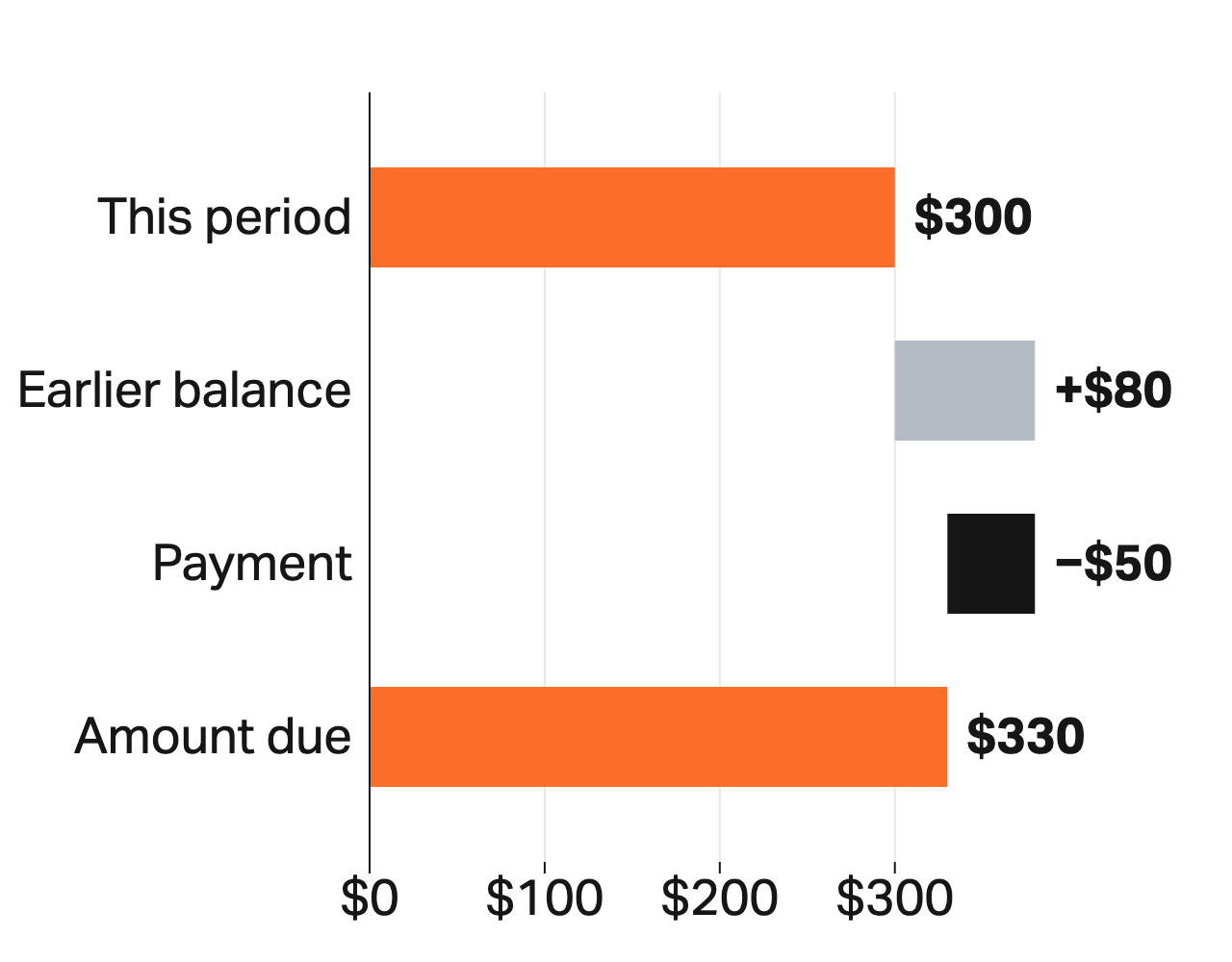
Now suppose the account had an $80 balance from an earlier bill and a $50 payment was received before this bill was prepared.
| Account item | Amount |
|---|---|
| Current charges | $300 |
| Earlier balance | +$80 |
| Payment received | −$50 |
| Amount due | $330 |
The amount due is $330. That includes $300 for this period and $30 left from the earlier balance. If you compare electricity offers using $330 as the cost of this period’s energy, the comparison will start with the wrong number.
A payment made after the bill’s issue date may appear in the online account before it appears on a later bill. Check the payment date and current balance before concluding it was missed. With regular instalments or bill smoothing, the amount transferred each month can also differ from the electricity charges accrued during that month.
Understand the units in the calculation
kWh measures energy: how much electricity adds up over time. Equipment drawing a steady 2 kW for three hours uses 6 kWh. At 30c/kWh, that electricity costs $1.80 in usage charges.
kW measures power: how quickly electricity is being used at a particular time or averaged over a stated interval. Demand tariffs use a measure of power, while ordinary usage charges use energy. Our visual kW and kWh guide explains the difference with everyday examples.
Some business demand lines use kVA, a different measure called apparent power. Do not replace a kVA quantity with a kW figure in the calculation. Ask the retailer to explain the unit and billed quantity if it is unfamiliar.
Watch the rate units too. A rate of 27c/kWh is $0.27/kWh. Multiplying 1,000 kWh by 27 dollars instead of 27 cents would overstate the charge a hundredfold. Daily supply may also be written in cents rather than dollars.
Match the details to your property
Check the customer name, supply address and billing period. The supply address is the property receiving electricity; a separate postal or billing address may be shown as well.
Find the account number, the meter details and the National Metering Identifier, usually shortened to NMI. The NMI identifies the electricity connection point. The account number belongs to your relationship with the retailer; the meter number identifies the device. These are useful references when discussing a bill, comparing an offer or checking that the right property has been billed.
Note both the issue date and the period of electricity use. A bill issued in October might cover electricity used across August and September. The payment due date is another date again. Compare consumption using the billed period, rather than the month in which an email arrived.
This is a useful map of the information to find, even when your retailer arranges it differently:
| Part of the bill | What to find | What it tells you |
|---|---|---|
| Property and period | Supply address, dates, NMI | Where and when the electricity was supplied |
| Meter and usage | Reading basis, kWh, tariff periods | How much electricity was measured or estimated |
| Current charges | Quantities, rates, fees and credits | What this period’s electricity cost |
| Account summary | Earlier balance, payments, adjustments | How the amount due is reached |
| Payment and help | Due date and retailer contact | When to pay and where to query a line |
If you receive bills for several sites, check each supply address before combining the costs. At home, check an opening or final bill carefully after moving. An incorrect date or account allocation can look like an unexplained change in electricity use.
Identify the tariff behind the usage lines
A tariff describes how electricity is charged. The name of the offer alone may not tell you which structure applies. Look at the usage lines, rate units and the tariff details in your agreement.
Flat or single-rate usage
One usage rate applies throughout the day. For example, 600 kWh at 30c/kWh costs $180 before adding supply and any other charges.
A single rate can still change from a specified date under the contract. If it changes partway through a billing period, the bill may split the usage between the old rate and the new rate. Several usage lines do not automatically mean you have time-of-use pricing.
Time-of-use pricing
Different rates apply at different times, often labelled peak, shoulder and off-peak. The hours may vary by weekday, weekend or season. Use the actual periods in your tariff; “peak” is a pricing label, not a universal rule that all daytime electricity is expensive.
Consider this invented usage-only example, with GST included:
| Usage period | Energy | Rate | Charge |
|---|---|---|---|
| Peak | 400 kWh | 45c/kWh | $180 |
| Shoulder | 200 kWh | 25c/kWh | $50 |
| Off-peak | 400 kWh | 20c/kWh | $80 |
| Total | 1,000 kWh | Weighted average 31c/kWh | $310 |
The total is 1,000 kWh and the usage charge is $310. The weighted average usage rate is therefore 31c/kWh. Averaging the three advertised rates equally would give the wrong result because different amounts of electricity were used in each period. Supply and any other charges still need to be added.
Block or stepped pricing
A block tariff applies one rate to an initial quantity and another rate to subsequent quantities. The blocks can reset over the period specified by the tariff. Check whether the threshold is daily or linked to the whole billing period before reconstructing the calculation.
For an illustrative 30-day tariff with a first block of 10 kWh per day, the first-block allowance is 300 kWh. If total use is 500 kWh, 200 kWh falls into the next block. Apply the specified rate to each block. This example only fits a tariff that allocates the allowance across the billing period that way.
Controlled load
Controlled load supplies eligible equipment on a dedicated circuit, commonly electric hot water or some heating systems. In NSW, bills may show Controlled Load 1 or Controlled Load 2. These lines have their own consumption and rates; any additional fixed charge depends on the offer.
Controlled load is different from choosing to run an ordinary appliance off-peak. Access depends on the circuit, metering and supply arrangement. Check the available operating hours before comparing it with another hot-water or heating option.
Wholesale-linked or dynamic pricing
Some offers pass through changing wholesale electricity prices. A bill may group many interval prices into a summary or average, alongside network and service charges. Ask how that average is weighted and what it includes. A quoted low wholesale price for one interval cannot explain the whole bill. Use the offer’s full calculation and your actual timing of use.
Check daily supply and demand separately
Daily supply is a fixed charge for each day of supply. It generally continues when the property is empty or the business is closed. Multiply the daily rate by the number of billed days. A longer billing period increases this line even if daily electricity use is unchanged.
Demand is an additional charge on some household and small-business tariffs. It is based on power drawn under the tariff’s measurement rules. Those rules can specify eligible hours, averaging intervals, seasons, minimum quantities and how long a measured peak remains relevant.
For a limited example, assume the tariff uses an eligible 5 kW demand quantity and a rate of 20c/kW/day for 30 days. The charge is 5 × $0.20 × 30 = $30. This assumes the billed quantity really is 5 kW under that tariff. The total kWh used during the month does not supply that number.
Do not multiply by the days again if the quoted rate is already per month or per billing period. If the line uses kVA, use the billed kVA quantity. Ask for the peak date, measurement window and formula if the bill does not provide enough detail. Our demand-charge guide gives a fuller visual explanation.
Recognise credits, fees and other adjustments
Usage and supply are only part of some bills. These are other lines you may encounter:
| Possible line | What to check |
|---|---|
| Solar feed-in credit | Exported kWh, export rate and any time or quantity conditions |
| Concession or government rebate | Eligibility, amount and the period it covers |
| Discount or retailer credit | Which charges qualify, conditions and expiry |
| Metering or recurring service fee | Whether it is included in the rates or charged separately |
| Connection, disconnection or special service | What service occurred and the applicable fee |
| Payment, paper-bill or late fee | Why it applies under the agreement |
| Adjustment or rebill | The original period and what has been corrected |
| GST | Whether rates and totals include it already |
Check the date and description of an unfamiliar item. A one-off connection fee deserves a different explanation from a recurring service charge. If a credit you expected is missing, check its eligibility and payment timing with the retailer rather than treating the expected amount as already paid.
Network costs cover transporting electricity through poles, wires and related infrastructure. Many residential and small-business offers incorporate these costs into the retail rates. Other arrangements itemise network, metering or environmental costs. Do not add an estimate of those underlying costs on top of a retail bill that already includes them.
GST can be shown within rates or added to a subtotal. Read the labels before doing the arithmetic and compare offers on the same GST basis. A displayed GST summary may already be included in the total. Credits can have different tax treatment, so follow the bill’s itemisation instead of applying another 10% to every line.
Read solar and battery bills through the meter
For a typical net-metered solar property, the bill records electricity imported from the grid and electricity exported to it. Solar used directly inside the property usually does not pass through the import register. Your home or business can therefore use more electricity than the imported kWh shown on the bill.
In this separate illustrative example, the property uses 900 kWh, while the bill records 500 kWh imported and 200 kWh exported. The difference is solar electricity used directly on site.
The panels generate 600 kWh over the period. Of that, 400 kWh supplies the property and 200 kWh goes to the grid. The property also buys 500 kWh from the grid, bringing total use to 400 + 500 = 900 kWh.
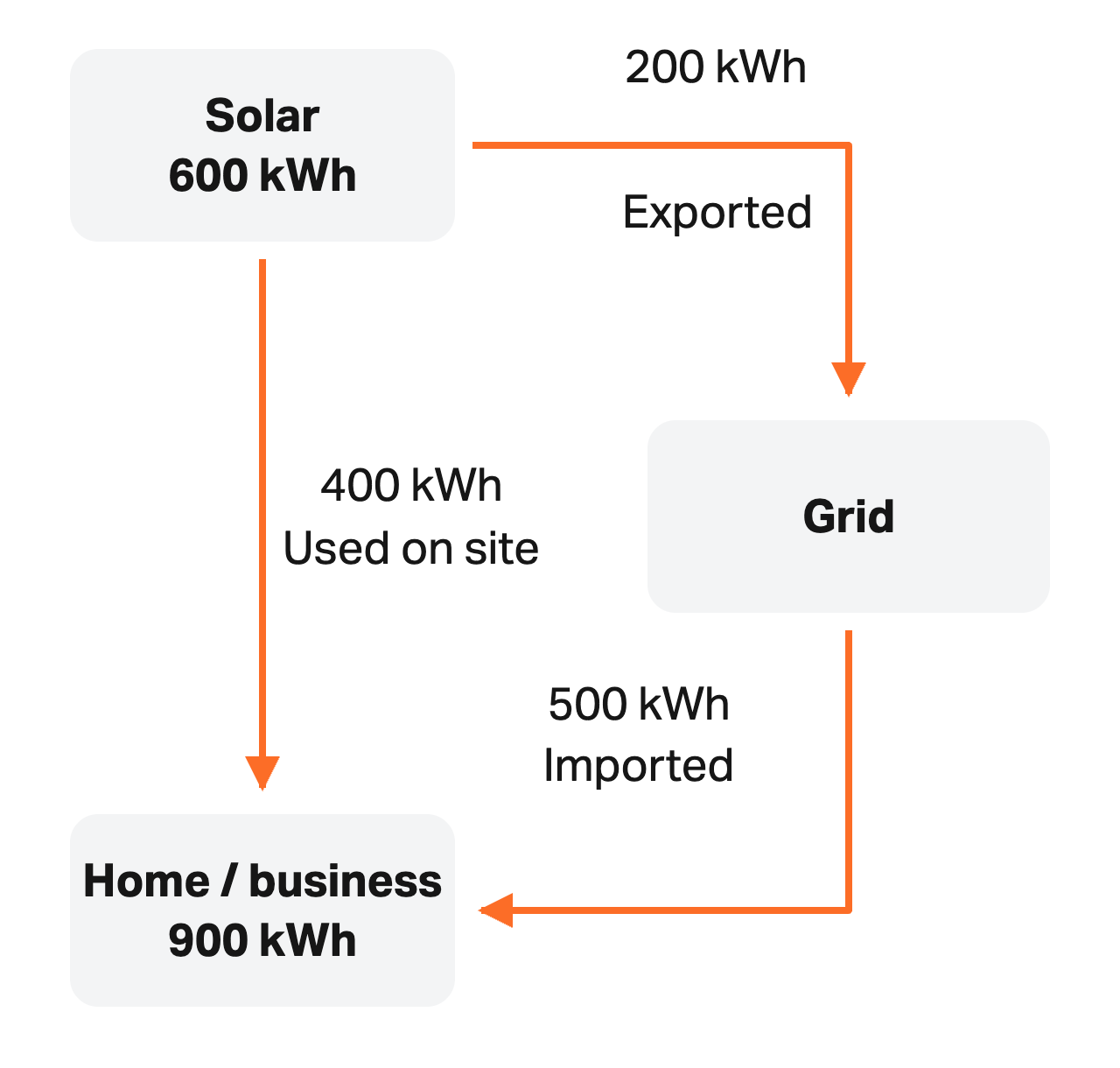
All quantities cover the same period, with no battery. Imports and exports can happen at different times. The arrows show direction; their width does not represent the amount of energy. Check the inverter or solar monitoring data for generation and on-site use, alongside the import and export figures on the bill.
If the export credit is 5c/kWh, 200 kWh earns $10 under that example rate. Imported electricity is charged separately at the applicable import rates. Subtracting exported kWh from imported kWh and pricing the result at one rate would miss the difference between what you pay and what you receive.
Some arrangements have time-varying export prices, export-related charges or rewards. Network export pricing does not automatically establish the retail line on your bill: check your retailer’s terms. Historic gross-feed-in arrangements also work differently from the net-metered example above.
A battery changes when electricity passes through the meter. Grid imports may include energy charging the battery, while later stored energy supplies the property. Use the battery and solar monitoring data alongside the bill, allowing for storage losses. A change in grid kWh by itself does not establish the battery’s financial saving.
Check whether the meter reading is actual or estimated
A bill should indicate when usage is estimated. Estimates can be used when actual readings are unavailable. A later bill based on an actual reading can correct the earlier estimate, producing an additional charge or a credit.
Compare the reading basis on both bills before interpreting a jump as a sudden increase in consumption. Check whether the new bill includes a correction for an earlier period and ask which dates it covers.
With a traditional accumulation meter, subtracting a previous reading from a current reading may help reconcile usage. Multiple registers, meter replacements or multipliers require extra care. A smart meter records usage in intervals; the bill may summarise those intervals into tariff categories rather than show one pair of cumulative readings.
If you suspect an error, ask the retailer for the relevant meter data and calculation. Use its process for submitting a customer reading where available. Do not open meter equipment or electrical enclosures to investigate a billing question.
Explain why one bill is higher than another
Start by adjusting for the number of days. A 900 kWh bill over 30 days and a 1,200 kWh bill over 40 days both average 30 kWh/day. Total use has increased because the second period is longer; daily use has not.
Then separate changes in usage from changes in rates. Return to the $300 electricity charges in our worked bill. In the next 30-day period, higher use and higher rates bring those charges to $396. Both examples include GST and exclude fees, demand and credits. The earlier balance and payment are outside this comparison:
| 30-day example | Earlier bill | New bill |
|---|---|---|
| Grid electricity | 1,000 kWh | 1,200 kWh |
| Usage rate | 27c/kWh | 30c/kWh |
| Usage charge | $270 | $360 |
| Daily supply | $1/day | $1.20/day |
| Supply charge | $30 | $36 |
| Total | $300 | $396 |
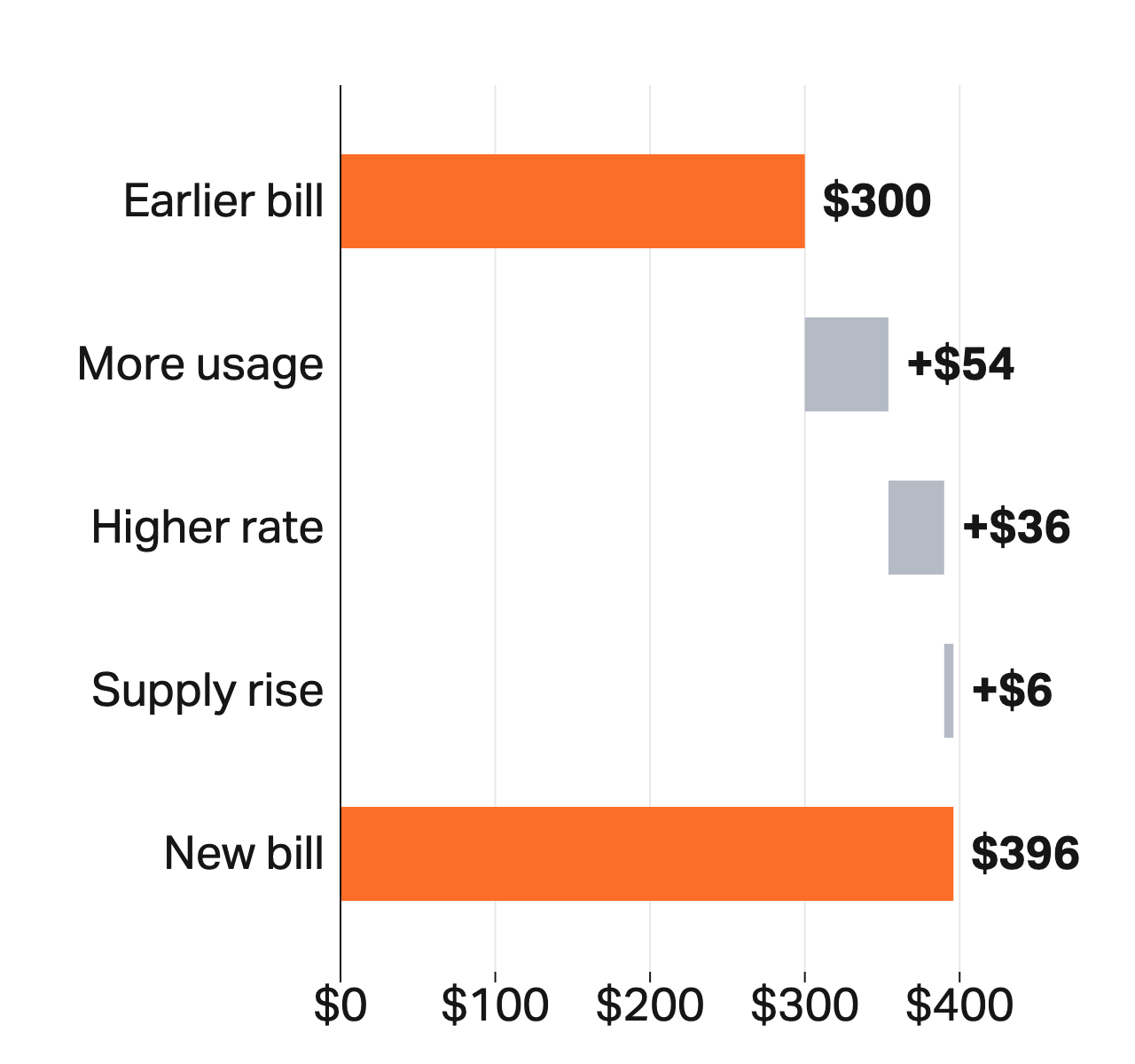
The increase is $96. One way to reconcile it is:
- Extra usage at the old rate: 200 kWh × 27c = $54.
- The rate increase across the new usage: 1,200 kWh × 3c = $36.
- The supply increase: 30 days × 20c = $6.
Those changes add to $96. We calculate the extra usage at the old rate first, then apply the rate rise to all 1,200 kWh on the new bill. Keeping that order avoids counting part of the increase twice. You can now see how much came from using more electricity and how much came from price changes.
For a home, investigate changes in occupancy, weather, hot water, heating, cooling or vehicle charging. For a business, check opening hours, output, equipment and maintenance. Compare a similar season where possible. A chart comparing your property with other households is context, not proof of a fault or an achievable savings target.
A reference-price percentage on an offer compares it with a regulated benchmark using specified consumption assumptions. It does not predict the percentage saving against your own bill. Use your actual usage for that comparison.
Know what to ask next
If something looks wrong, make the question specific: “My bill shows 1,200 kWh for this period. Which meter data supports that?” or “The demand line uses 5 kW. Which interval and tariff rule produced that quantity?”
Keep the bill, payment receipt where relevant, and the retailer’s response together. Ask for the explanation or correction in writing. If the issue remains unresolved, use the retailer’s complaints process and, where applicable, the energy ombudsman for your state. The route can differ for embedded networks and different customer categories.
If the calculation is correct, the useful next step is to decide what you can change: the offer, equipment use, timing or supply arrangement. Our guide to reducing electricity costs works through those options for homes and small businesses.
If you are considering Cable, use the same checks on our quote. It sets out proposed rates, estimated savings and terms for the site. Compare the complete cost using the same consumption, and ask us to explain any assumption you cannot follow.
Sources
- ACCC: electricity offers and wholesale pass-through pricing
- Australian Energy Regulator: reference prices
- Australian Energy Regulator: understanding your energy bill
- Energy Made Easy: account summary and bill reading
- Energy Made Easy: electricity tariffs
- Energy Made Easy: controlled loads and state-specific labels
- Energy Made Easy: discounts and fees
- Energy Made Easy: estimated bills
- Australian Government: solar, tariffs and feed-in credits
- Australian Government: understanding business energy use and solar metering
- Ausgrid: network tariff documents and price lists
- Australian Energy Regulator: export tariff guidelines
- Energy Made Easy: finding the connection identifier
- Energy & Water Ombudsman NSW: resolving a complaint