

Cable can lower your electricity price and earn a margin because the battery makes your business cheaper to supply. We buy and store electricity when it costs less, then use it when supplying your business would otherwise cost more.
Cable funds, owns and operates the battery. Lower supply costs give us room to offer you a better electricity price while covering the equipment and service.
How the battery lowers our supply costs
Your business needs electricity when the work happens. A restaurant cannot move dinner service to a cheaper hour.
A battery lets Cable buy some electricity when wholesale prices are lower, then use it when supplying the business would cost more. Cable manages the buying and battery decisions; you keep using electricity when the business needs it.
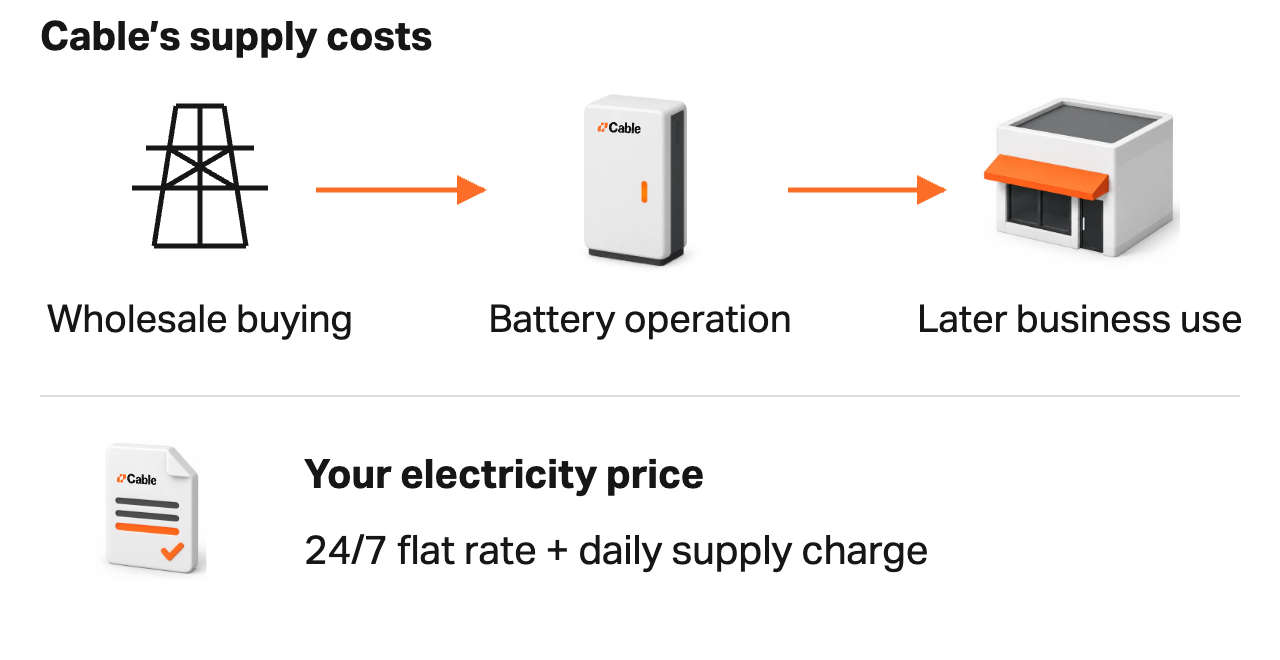
The battery only moves some of the electricity needed by the business. Charging uses electricity and loses some energy before it is delivered again. Installation, maintenance, eventual replacement, network charges and other supply costs remain.
Cable’s margin comes after those costs. The gap between a low and a high wholesale price is not the amount we earn or your business saves.
What you pay
Your bill uses the price in your offer: a 24/7 flat rate for each kilowatt-hour of electricity used, plus a daily supply charge. A kilowatt-hour measures an amount of electricity.
Your flat rate does not follow each movement in wholesale prices. Cable manages the purchasing, market risk and battery operation behind it. You do not need to follow the wholesale market or decide when to charge the battery. Your total bill still changes with how much electricity your business uses.
Cable also absorbs applicable network demand charges instead of adding a demand line to the customer’s bill. We still pay network costs and use the battery to help manage them. Our demand-charge guide explains why those costs depend on power drawn during particular measurement periods.
Cable manages the energy-market decisions
| Cable manages | You need to understand |
|---|---|
| Managing electricity purchasing and wholesale-market risk. | Nothing. |
| Charging, discharging and day-to-day battery operation. | You can keep using electricity when your business needs it. |
Why the site assessment matters
Two businesses with similar annual electricity use can present different opportunities. One may draw most of its power during expensive supply periods; another may have little demand then. Space, connection requirements and the cost of installation also affect whether the arrangement works.
Your quote shows the proposed bill based on when and how much electricity your business uses. Start there when deciding whether Cable creates worthwhile value for your business. For the physical explanation, see what a battery changes at your meter.