

Compare an electricity-and-battery offer using three numbers: your estimated electricity cost, the cash needed upfront and what you would pay if you left early.
A lower annual bill tells you about electricity cost. It does not tell you how much money is tied up in a deposit or what happens if you leave.
Compare the same usage and period
Use the same address, usage history and period in both estimates. Include seasonal changes and tell the provider about planned changes to opening hours, equipment, production or solar.
For time-of-use pricing, the estimate needs to reflect when you use electricity. For demand charges, it needs the applicable measurement rules and billed demand. For solar, it needs both imports and exports under each offer.
Our bill-reading guide explains the charges to find. The cost-reduction guide shows why the lowest usage rate can produce a higher total bill.
A battery proposal adds another question: what would change in those grid purchases, and who receives the benefit? Check that the estimate accounts for charging, losses, solar-export credits forgone and any separate equipment or service charges.
Put the complete arrangement on one page
| Compare | What you need from each offer |
|---|---|
| Electricity cost | Estimated usage, supply, demand and other recurring charges, less applicable credits. |
| Price changes | Indexation, other adjustment provisions, and when discounts or benefits end. |
| Money upfront | Deposits, equipment payments and site works, with due dates and refund conditions. |
| Responsibilities | Who owns, operates and maintains the battery; access and fault arrangements. |
| Commitment | The term, start date, notice requirements and end-of-term options. |
| Changed plans | Costs and conditions for cancellation, moving, selling, early exit and removal. |
Use the same GST basis in both columns. List one-off charges separately. Compare current electricity charges; an account balance can include earlier debts or payments.
A worked example: lower bills cover the deposit
A business is comparing ordinary electricity supply at $4,800 a year with an electricity-and-battery arrangement at $3,600 a year.
The battery arrangement requires a $900 deposit at the start, returned after three years if its stated conditions are met. There is no separate battery purchase charge in this example.
Assume identical electricity use, unchanged annual charges, GST included, and no other fees or credits.
| Illustrative comparison | Ordinary supply | Electricity + battery |
|---|---|---|
| Electricity charges in year one | $4,800 | $3,600 |
| Deposit paid at the start | $0 | $900 |
| Cash paid by the end of year one | $4,800 | $4,500 |
| Electricity charges over three years | $14,400 | $10,800 |
| Deposit returned at the end of three years | $0 | $900 |
| Net amount paid over the full term | $14,400 | $10,800 |
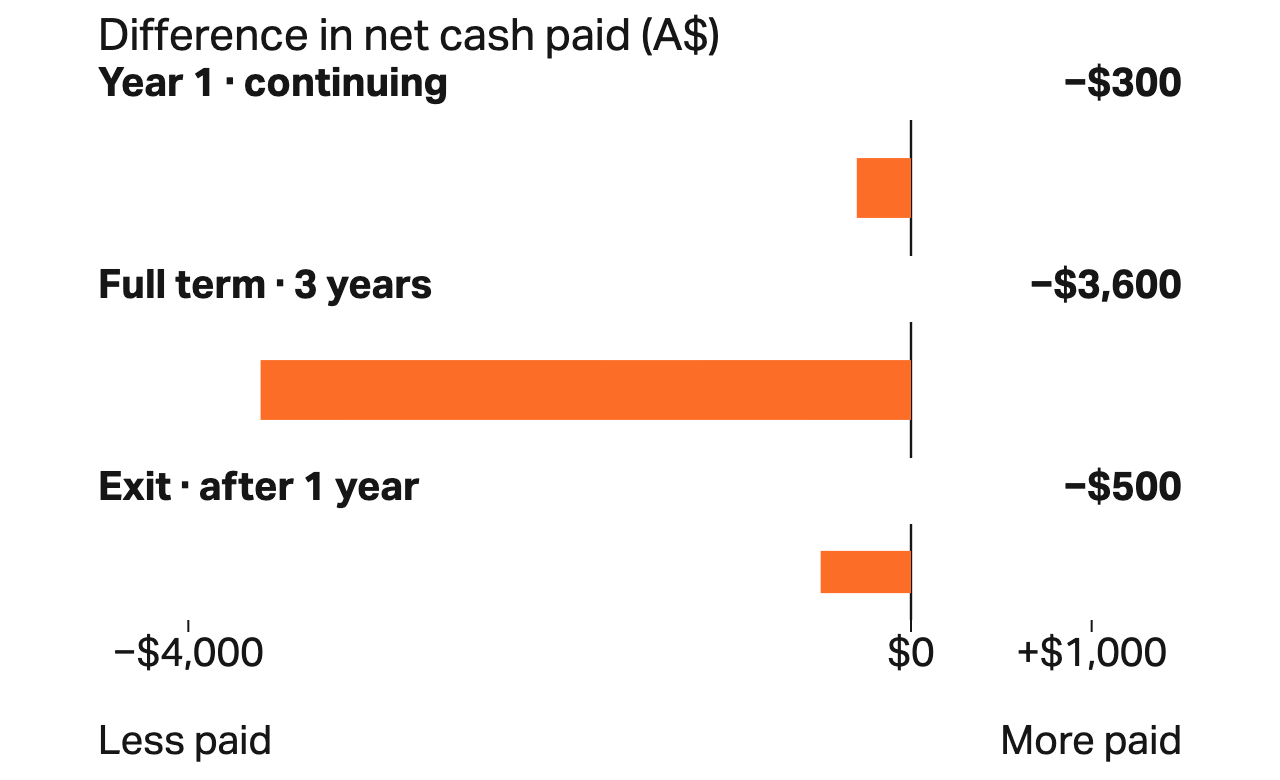
The electricity saving is $1,200 a year. That covers the $900 deposit within year one, leaving the business $300 ahead in cash paid at the end of that year.
Over three years, the business saves $3,600 on electricity and receives its deposit back if the return conditions are met.
Now test an early exit
Keep the same invented arrangement, but suppose the business leaves after one year. Assume an early-exit charge of $700 is taken from the $900 deposit and the remaining $200 is returned. Ordinary supply has no exit fee in this example, and there are no other exit, removal or reinstatement charges.
The business has paid $3,600 for electricity and $700 for leaving: $4,300 in total. Ordinary supply would have cost $4,800 over the same year. The business is still $500 ahead in this scenario, although leaving early reduces the electricity saving.
Repeat the calculation using the real offer, including any balance, removal or site-work costs. If it depends on a new occupant taking over, check what happens if they decline or cannot qualify.
Apply the comparison to a Cable quote
Cable’s current offer combines a 24/7 flat rate and daily supply charge with a three-year initial term and a separate refundable deposit. Your personalised offer identifies the amounts, return conditions and early-exit arrangements.
Check the electricity and battery agreements together, alongside your lease dates and existing retailer contract.
Before signing, get one comparison that shows the expected electricity cost, cash required and outcome if you leave on a specified date. Use the worked example as a method, then check the result against the actual offer.
Sources
- How estimated plan costs are calculated — Energy Made Easy
- Battery costs and financial considerations — Australian Government
- Cable’s current pricing, deposit and contract answers
- Worked examples: Cable editorial calculations using explicitly invented assumptions.