

Start with the bill and the electricity offer, then look for equipment doing unnecessary work. Those checks help you find changes worth making before spending money on new equipment, solar or a battery.
A lower bill can come from buying fewer kilowatt-hours (kWh), paying less for them, or moving suitable tasks to a cheaper time on a tariff that rewards it. The useful starting point depends on what is driving your costs.
This guide covers Australian households and small businesses, with NSW examples. It explains how to compare offers, check everyday routines and assess larger investments. Illustrative calculations show the method; your own rates, operating needs and available offers determine the result.
Find what is making the bill expensive
Put your latest bill beside an earlier one. Compare the number of days, electricity bought from the grid, usage rates, daily supply charge and any demand charges. Then check credits and the account balance. A bill covering 95 days should not be compared directly with one covering 80.
Write down the current electricity charges separately from the amount due. The amount due can include an unpaid balance, a payment or an adjustment from another period. Those account movements can change what you owe without changing the cost of this period’s electricity.
Look for whether the meter reading is actual or estimated. A correction to an earlier estimate can explain a sudden jump. If a number does not reconcile, ask the retailer for the calculation before using it as the starting point for a savings estimate.
Our guide to reading an electricity bill walks through a complete example. Once you have the basics, use the pattern you see to decide where to investigate.
| What changed? | Where to start |
|---|---|
| More kWh per day | Equipment, weather, occupancy and operating hours |
| Similar kWh, higher usage cost | Rates and the mix of peak, shoulder and off-peak use |
| High use while the property is empty | Timers, unnecessary loads and essential overnight equipment |
| A demand line is driving the total | The measured peak and the tariff’s rules |
| Lower credits or a higher balance | Export prices, rebates, discounts and account movements |
For a household, useful context includes how many people were home, heating or cooling use, and whether an electric vehicle was added. For a business, include opening hours, production, refrigeration and changes in equipment. A busier shop can use more electricity while becoming more efficient per customer served.
See which charges fall when you use less
Buying fewer kWh from the grid reduces the usage charge at the applicable rate. The daily supply charge generally continues for every day the property remains connected. A demand charge follows its own calculation. This is why a 20% reduction in electricity use does not automatically mean a 20% reduction in the whole bill.
Take an illustrative 30-day bill at 30c/kWh, plus $1 a day for supply. All rates and amounts in this example include GST. There are no demand charges, credits, discounts or other fees.
| 30-day example | Usage charge | Supply | Total |
|---|---|---|---|
| 1,000 kWh | $300 | $30 | $330 |
| 800 kWh | $240 | $30 | $270 |
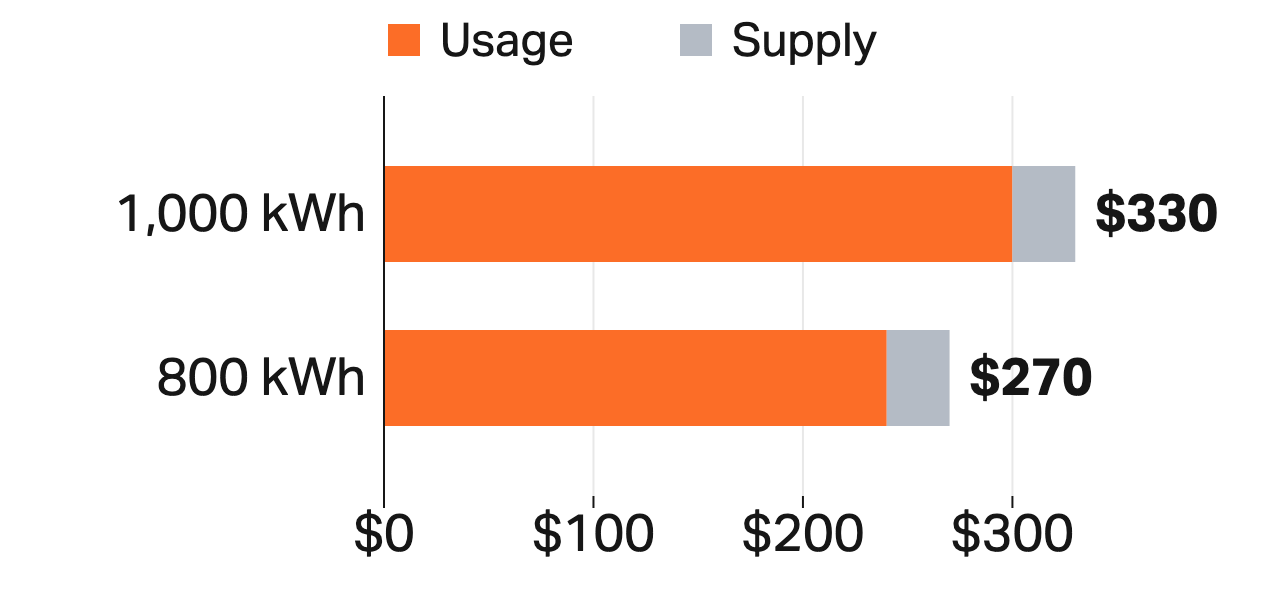
The saving is $60: 200 fewer kWh multiplied by 30c. Usage has fallen 20%; the total bill has fallen about 18%. The $30 supply charge is unchanged.
Use the rate for the electricity you would actually avoid. With time-of-use pricing, a kWh avoided in a peak period can be worth more than one avoided off-peak. If solar would have supplied it, the financial effect also depends on what happens to that unused solar electricity.
Compare offers using the whole bill
A cheaper offer can save money without changing how you use electricity. It is worth checking before buying equipment or reorganising a household or workplace routine.
Compare offers using the same usage, dates and tariff assumptions. A recent bill is a useful start; a year of data captures more of the seasons. If the retailer can use your smart-meter data with your permission, the estimate can reflect when you use electricity as well as the total.
For a flat-rate offer, check both the usage rate and the daily supply charge. In the comparison below, Offer B costs $10 less over 30 days, even though it has the higher price per kWh. Its lower daily supply charge makes the difference.
Both invented offers use the same 1,000 kWh over 30 days. Prices include GST and exclude demand charges, exports, discounts and fees.
| Illustrative offer | Usage rate | Supply per day | 30-day total |
|---|---|---|---|
| Offer A | 25c/kWh | $2 | $310 |
| Offer B | 27c/kWh | $1 | $300 |
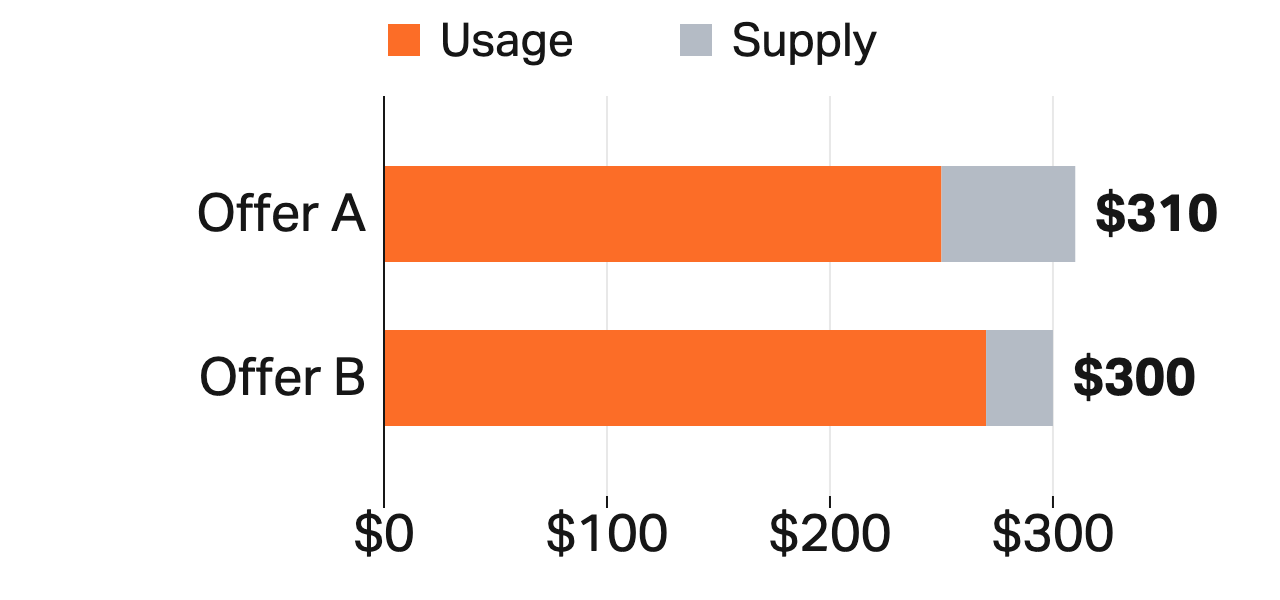
Offer A: 1,000 × $0.25 + 30 × $2 = $310. Offer B: 1,000 × $0.27 + 30 × $1 = $300.
At 1,500 kWh over the same 30 days, both cost $435. Your consumption changes the comparison, so use your own figures when choosing an offer.
For time-of-use offers, compare the rates and hours for each period. For demand tariffs, include the demand calculation. For solar, compare what you pay to import electricity as well as what you receive for exports. A large discount or high feed-in rate tells you very little about the final annual cost on its own.
Check how long any discount lasts, what it applies to and whether you meet its conditions. Read the contract term, price-change rules, payment fees and exit conditions. A flat rate means one usage rate across the day; it does not by itself mean that rate is fixed for the life of the contract.
In NSW, start with Energy Made Easy, the Australian Government’s comparison service. It also covers ACT, Queensland, South Australia and Tasmania; available choices vary by location. Victoria has Victorian Energy Compare. Retailer choice is more limited in some other areas. If you buy electricity through a landlord or an embedded network, first check how switching works at your property.
With wholesale-linked or dynamic pricing, check the full cost calculation and how much exposure you take to high-price periods. Your timing and ability to respond matter. A low wholesale price at one moment does not establish a low annual bill.
Find equipment running longer than it needs to
An empty building can still have a busy electricity meter. Check timers, heating schedules, hot-water settings and equipment left ready for the next day. Some of that use is essential; some may continue because nobody has revisited a setting.
A smart-meter portal may show usage in short intervals. Compare an ordinary working day with a closed day, or an occupied evening with a period when everyone is away. A persistent overnight load is a clue to investigate. It can include necessary refrigeration, medical equipment, security or other essential services.
Make a short equipment list: what it does, when it needs to run and who controls it. For a business, give one person responsibility for reviewing closing routines. At home, agree schedules that suit the people who live there. A timer that is repeatedly overridden probably needs a better schedule.
In this illustrative example, removing three unnecessary running hours saves 6 kWh a day. Across 200 operating days, that is 1,200 kWh, worth $360 at 30c/kWh, including GST.
The chart shows a constant 2 kW load running from 9 am to 8 pm. Only 9 am to 5 pm is needed in this example. Changing the timer removes the orange area: 2 kW × 3 hours = 6 kWh each day. Both panels use the same scales.
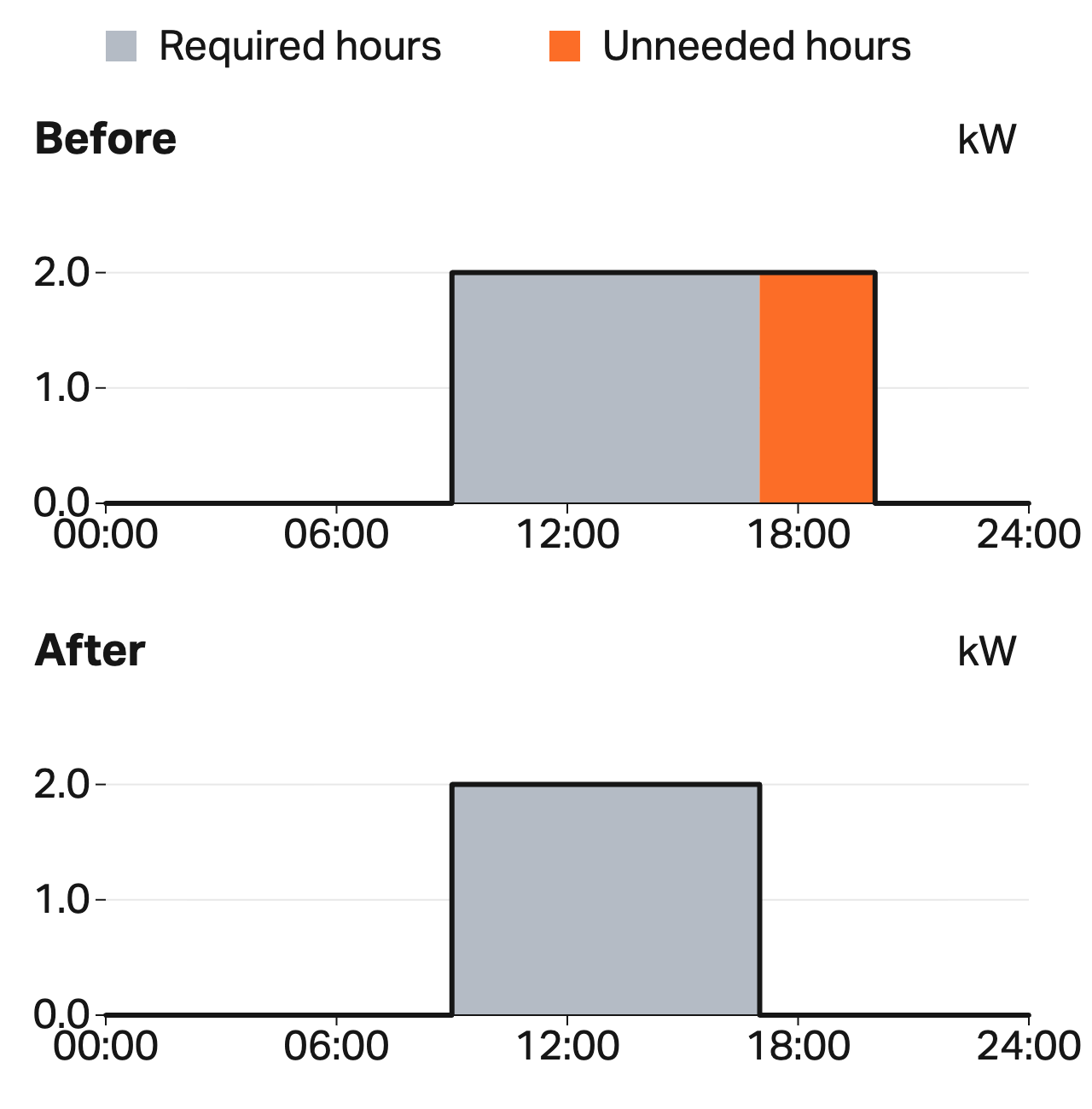
The annual calculation is 6 kWh × 200 days × $0.30 = $360 in usage charges. Supply and any demand charges need separate assessment. This assumes a steady 2 kW throughout those hours; equipment that cycles on and off needs measured consumption. Confirm which hours are genuinely avoidable before changing a timer, especially for refrigeration, hot water or essential services.
Measure a promising change before multiplying it into an annual saving. A power label can show maximum input rather than typical running consumption. For hardwired equipment or a fault investigation, use a qualified electrician or service technician.
Match the action to the equipment
The largest useful opportunity depends on the property. Focus on equipment with substantial consumption or long running hours, then choose changes that preserve its job.
Heating and cooling
Check schedules, filters and servicing. Heat or cool the spaces being used, and reduce avoidable heat loss or gain through doors, windows and shading. Follow the equipment instructions when adjusting controls.
At home, consider whether a portable resistance heater is doing work that an existing efficient reverse-cycle air conditioner could do. In a shop or office, check whether air conditioning starts long before opening or keeps running after closing. Building layout, climate and comfort needs determine the practical choice.
Hot water, washing and drying
Look at how much hot water is needed and when. Fix leaks, choose suitable efficient fixtures and use cold washes where appropriate. Air drying can avoid dryer use when space, weather and the task allow it.
When replacing a hot-water system, compare running costs, installation costs and suitability. A heat-pump system may be worth assessing. If the existing system uses a controlled-load circuit, include its tariff and available heating hours in the comparison. Keep hygiene and safe temperature requirements intact.
Refrigeration
Check door seals, airflow around equipment, servicing and exposure to heat. A second household fridge that is rarely used deserves a running-cost check. A café’s display fridge or cool room deserves a maintenance and operating review.
Maintain the temperatures needed for safe storage. Switching off essential cooling or changing a defrost setting without understanding the equipment can create a much larger cost than the electricity saving.
Lighting, pumps and business equipment
Match lighting to occupied areas and operating hours. Compare suitable efficient replacements when fittings need attention. Check pool-pump schedules at home and process schedules at work against their actual requirements.
For workshops, compressed-air leaks and equipment idling between jobs are worth investigating. Have a competent technician assess pressure, controls and repairs. For offices, check sleep settings and automatic shutdowns that will not interrupt updates or required services.
Move flexible use when your tariff rewards it
On a time-of-use tariff, some electricity costs more because of when it is used. Moving a flexible task can reduce the charge without reducing the task’s energy consumption.
Suppose 10 kWh can move from a period priced at 45c/kWh to one priced at 20c/kWh. Its energy cost falls from $4.50 to $2, a $2.50 saving. Both rates include GST. Supply charges and all other bill items are unchanged in this example.
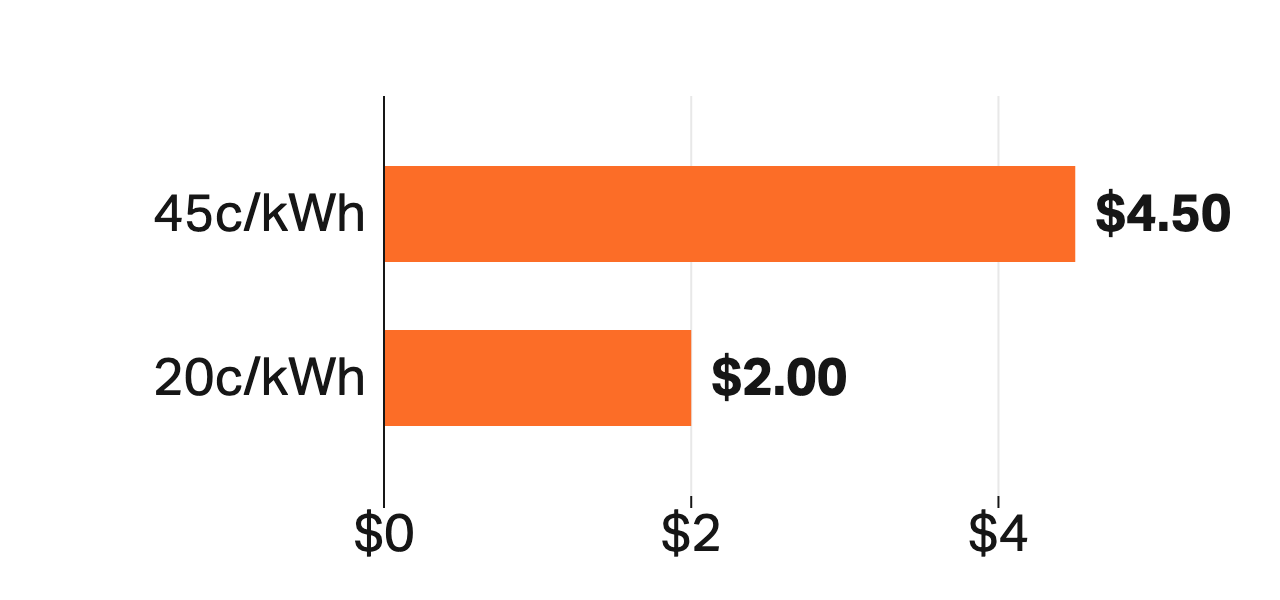
A household might move suitable vehicle charging, washing or pumping. A business might reschedule a flexible batch process or charging task. Use your own tariff’s hours and the equipment’s operating requirements; there is no single cheap time that applies to every Australian electricity customer.
On a flat usage rate, moving the same grid consumption to another hour does not reduce that usage charge. Solar, a demand charge or another part of the arrangement can still make timing valuable. Check those separately before deciding a schedule has saved money.
Check whether running equipment together sets a demand charge
Some residential and small-business tariffs include demand charges. These reflect the amount of power drawn during the tariff’s measurement periods, which may be expressed in kW or kVA.
If a billed peak comes from several large appliances running together, spreading flexible tasks may reduce it. First check the qualifying hours, measurement interval, season and how long a peak affects the charge. A different peak elsewhere in the period can still set the bill.
Think about the overlap: vehicle charging, cooking and heating at home; compressors, ovens and air conditioning in a business. The practical question is which loads can move without disrupting people or the work being done. Our demand-charge explainer shows how a measurement becomes a charge.
Use solar well, then assess storage
Solar produces electricity during the day. The value of using it on site depends on the grid electricity it replaces and the export credit you give up.
In an illustrative net-metered arrangement, moving 5 kWh of existing consumption into a period with surplus solar avoids imports priced at 30c/kWh and gives up exports worth 5c/kWh. The improvement is 5 × (30c − 5c) = $1.25. The example assumes enough surplus solar, unchanged total consumption and no other tariff effects. Historic gross-feed-in arrangements work differently.
Move useful tasks into suitable solar hours. Running extra equipment solely to absorb surplus generation does not create the avoided-import saving in this example. A business that closes on weekends should include those quieter days when assessing a system. A household away all day should look at the loads it can actually move.
A battery can store solar or grid electricity and supply it later. Assess the complete arrangement: capacity, power output, losses, operating schedule, purchase or service costs, and who controls it. Some of the electricity used to charge a battery is lost before it is delivered again.
Avoid counting the same saving twice. If a solar estimate assumes all surplus generation earns export credits, a battery estimate that stores that surplus must subtract the credits forgone. If efficiency improvements reduce the electricity you use later, update the battery estimate as well. See our battery-value guide for a fuller assessment.
Choose investments you can measure
Separate changes you can make now from purchases that need a quote. Start a shortlist with the expected annual kWh saving, the relevant electricity rate, implementation cost and any additional maintenance or service cost.
As an illustrative first check, a $1,200 improvement saving $300 a year has a four-year simple payback. That calculation excludes financing, changes in prices, maintenance and the value of money over time. It also assumes the saving continues. Check the expected equipment life and, for tenants, whether you will remain long enough to receive the benefit.
Use a cautious estimate if operating hours or savings are uncertain. A business considering replacement equipment should include productivity, service reliability and installation downtime. A household should include comfort and whether the change is realistic to maintain. The best choice need not be the option with the shortest spreadsheet payback.
Check current rebates before committing, including eligibility, approved products and installation requirements. An incentive can improve the economics, but it does not establish that the equipment is suitable for your property.
Put the first changes into practice
In the first week, collect the bill and usage data, check the tariff, and identify any unexplained charge. Compare available offers using the same consumption. Record the existing rates and daily usage so you have something to measure against.
Next, choose one or two practical changes. Record what changed and when: a timer, equipment repair, tariff change or operating routine. Keep the work small enough that you can tell whether it helped.
When the next bill arrives, compare like with like. Use kWh per day, note weather and occupancy or opening hours, and separate rate changes from changes in consumption. A lower amount due after a one-off credit is useful cash relief, but it does not show that the property has become more efficient.
If paying the bill is the immediate problem, contact the retailer about payment options and available support. Check household concessions or rebates through your state or territory. Eligibility differs, and household programs do not automatically apply to a business account.
Where Cable fits
Cable brings electricity supply and battery operation together. We operate the Cable battery to reduce the cost of supplying electricity. Whether the arrangement creates worthwhile value depends on the property and its electricity use.
A Cable quote sets out the proposed rates, estimated savings and terms for the site. Compare it with your current offer using the same consumption. Ask us to explain what changes, what you pay and how the estimate was calculated, so you can decide whether the value is worthwhile for your property.
Sources
- ACCC: electricity offers and wholesale pass-through pricing
- Energy Made Easy: electricity tariffs
- Energy Made Easy: discounts and fees
- Australian Government: pricing plans, solar tariffs and comparison services
- Australian Government: reducing household energy bills
- Australian Government: household heating and cooling
- Australian Government: business energy savings
- Australian Government: refrigeration
- Australian Government: compressed air
- Australian Government: batteries
- Energy Made Easy: buying electricity from a landlord